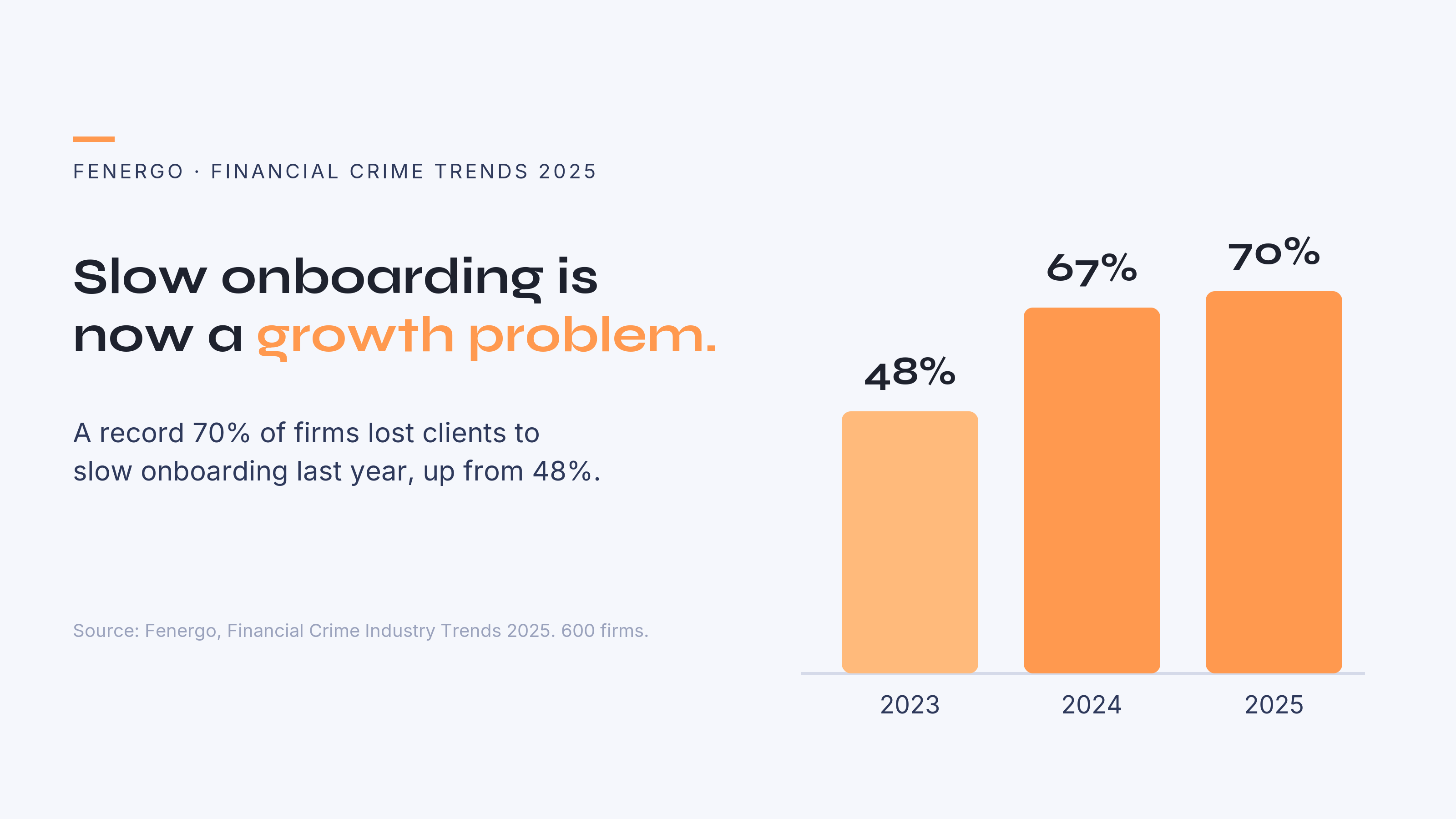
Fenergo's Financial Crime Industry Trends 2025 surveyed 600 senior decision-makers across banks, asset managers and fund administrators. The headline number should stop any lender in their tracks. 70% lost clients in the past year to inefficient onboarding, up from 67% in 2024 and 48% in 2023. In two years, a problem that touched half the market now touches seven firms in ten.
The cost of running the function keeps climbing too. Firms now spend an average of US$72.9m a year on AML/KYC operations, with UK institutions highest at US$78.4m. And here's where it gets pointed for UK lenders: across the three markets studied, UK corporate banks report the slowest onboarding of all, averaging more than six weeks. Six weeks is plenty of time for a customer to walk to a competitor, and roughly one in ten now do. Abandonment sits around 10%.
AI adoption is up, but the bottleneck hasn't moved. Use of advanced AI in KYC and AML nearly doubled in a year, from 42% to 82%. Yet client losses still hit a record high. That tells you something worth taking seriously: bolting AI onto a broken data process doesn't fix the process. If the underlying customer data is scattered across documents, bureaux and inboxes, a smarter model just makes faster decisions on incomplete inputs.
The delay is data gathering, not risk assessment. The slow part of onboarding is rarely the credit or compliance call. It's collecting, chasing and re-keying the information that call depends on: identity documents, proof of income, bank statements, company records. That manual work is where the weeks go, and it is exactly the part worth automating.
Speed and rigour are not a trade-off. Firms losing clients aren't choosing to be slow. They're stuck with processes that force a choice between moving fast and getting it right. Automating the data layer removes that choice. You verify more thoroughly and faster, because the data arrives complete instead of in pieces.
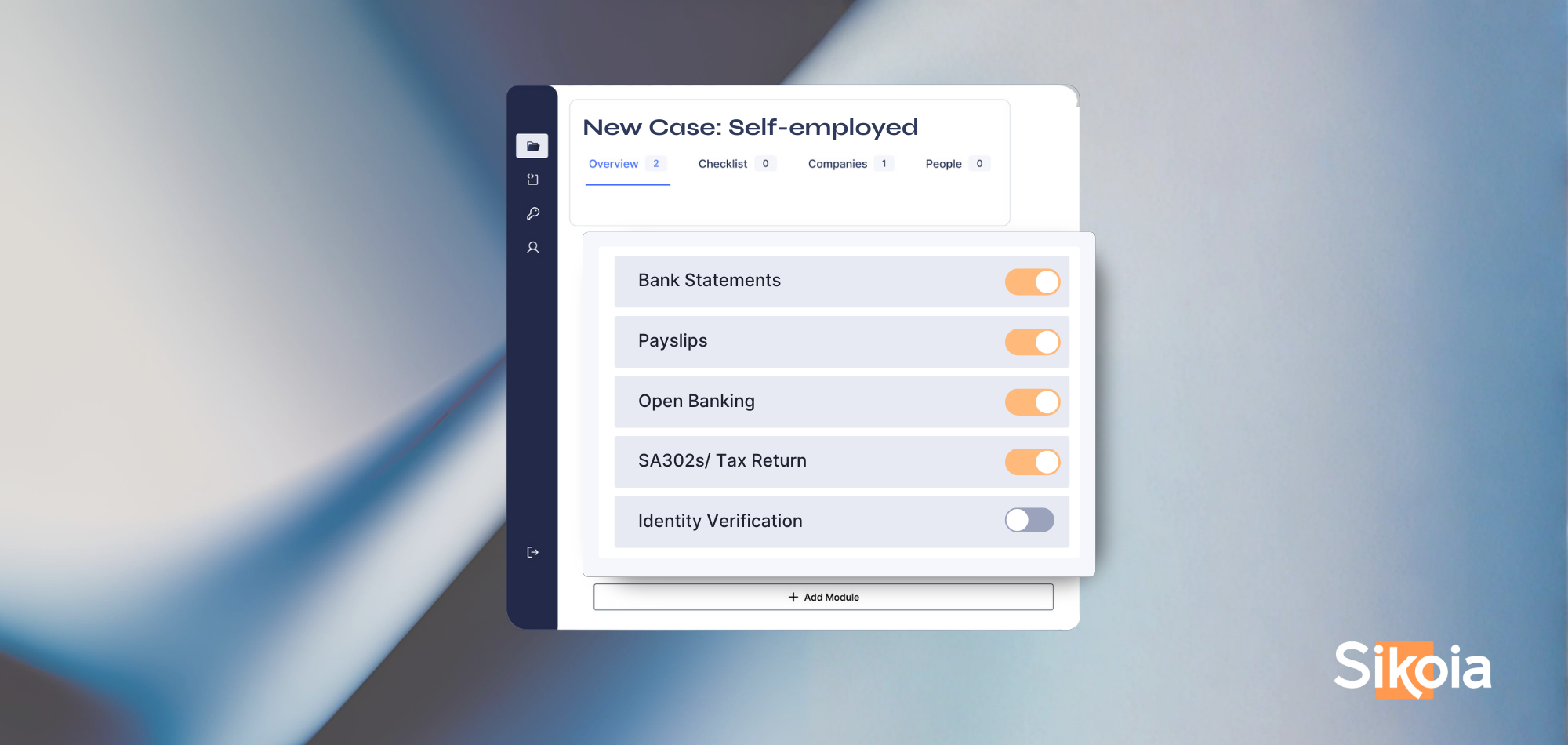
This is the problem Sikoia is built to solve. We aggregate a customer's data from every relevant source, verify identity, income, employment and affordability, and run document integrity checks, so your team decides on complete, current data in minutes rather than weeks. Manual checks that used to take 30+ minutes per case take seconds.
Onboarding is now the moment you win or lose a customer. If yours is measured in weeks, that's a growth problem worth fixing.
See how Sikoia speeds up onboarding, book a call.


.png)





.png)


.png)


.png)


.png)


%20(2).svg)


