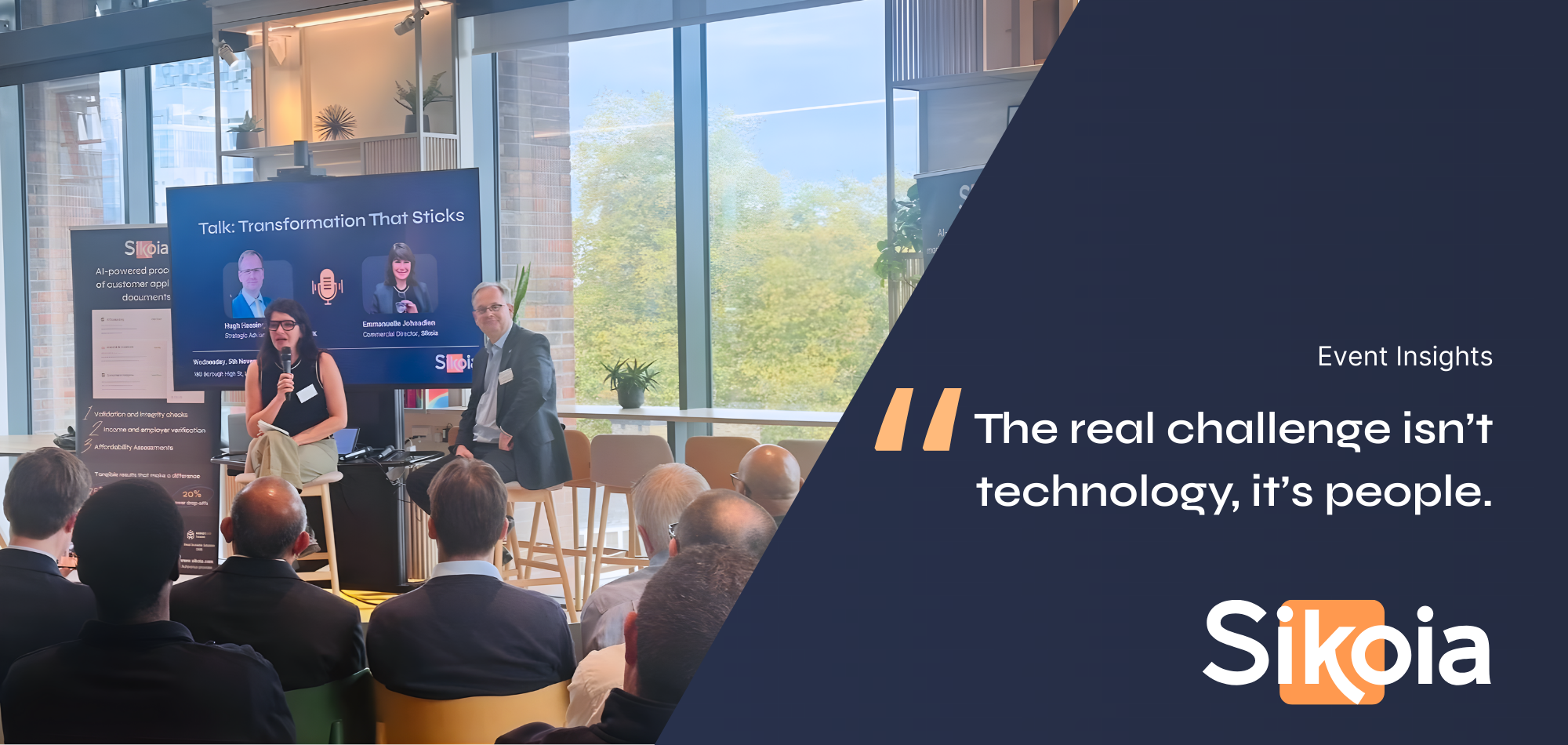
In an industry racing to adopt AI, digitise customer journeys, and modernise legacy systems, it’s easy to assume that technology is the hardest part of change. But as we heard in our closing talk, Transformation That Sticks, the real barriers and the biggest opportunities sit with the three C’s that shape every successful transformation: a culture that embraces change, clarity on what good looks like, and a customer focus that keeps teams aligned on the outcomes that matter.
Drawing on years of experience leading major change programmes across banking, insurance, and financial services, transformation expert Hugh Hessing offered a refreshingly honest view of why so many transformations fail to deliver their full potential, and what needs to shift if we want change to last.
The core message was clear: technology isn’t the hard part - people are.
1. Most transformation programmes fail because nobody knows who owns what
Hugh opened with a sharp observation that resonated across the room:
“Nine out of ten people in large organisations are hired to say no.”
Layers of approvals, risk controls, committees, and “just-in-case” governance structures slow decisions to a crawl. The result is that teams become excellent at protecting the business, but struggle to move it forward.
For transformation to take hold, Hugh argued, organisations need:
- Clear ownership over decisions
- Aligned priorities between product, risk, and operations
- A willingness to remove low-value complexity
Technology can support that shift, but it cannot create it.
2. Real change happens through small, fast-moving ideas, not large programmes
Hugh challenged the industry’s habit of planning multi-year, multi-workstream transformation programmes.
His perspective was simple: “Big transformations fail because they try to fix everything at once. Lasting change comes from smaller ideas that deliver value quickly.”
This approach mirrors what we see across our own ecosystem:
- Lenders launching specialist journeys in weeks
- Brokers adopting automated verification tools in days
- Teams experimenting with AI to simplify manual tasks
The organisations that win are the ones that ship, learn, refine, and repeat - instead of waiting for the “perfect” solution.
3. Culture is the real driver of sustainable innovation
Throughout his talk, Hugh returned to a central theme: culture determines whether transformation lasts or disappears the moment a project ends.
A resilient transformation culture has three components:
- Curiosity, teams ask why processes exist, not just how
- Empathy, decisions are made from the customer's point of view
- Accountability, teams are empowered to act, not just escalate
Without these, even the best technology eventually becomes another layer of legacy.
4. Compliance and speed don’t need to be at odds
A significant part of the discussion focused on the perceived tension between automation and risk.
Hugh’s view was more optimistic. Complexity often grows when organisations try to “design out” every possible risk scenario. Instead, he argued for data-driven compliance models that help teams focus on what actually matters.
This mirrors what we see at Sikoia, where verified data, provenance, and audit trails allow lenders to automate confidently - not recklessly. When trusted data underpins decisions, speed and compliance reinforce each other, instead of competing.
5. Listening to customers, especially the ones not yet in the room
Hugh closed with a reminder that the industry’s future customers may not look anything like today’s.
Younger generations expect digital-first journeys, clean design, instant decisions, and intuitive onboarding. They trust technology differently, often more readily, and have little patience for repetition or unnecessary friction.
As Hugh put it:
“The question isn’t whether customers will adopt digital journeys - it’s whether those journeys will meet the expectations of the next generation.”
The challenge now is not simply digitising old ways of working, but designing journeys for customers who already live in a digital-first world.
Transformation that sticks
The takeaway from Hugh’s session was powerful:
- Technology will continue to evolve.
- Regulatory expectations will continue to grow.
- Customer behaviour will continue to change.
But the organisations that thrive will be the ones that build cultures where teams can move quickly, collaborate openly, and make decisions with clarity and confidence.
At Sikoia, we share that ambition, enabling lenders and financial institutions to combine compliance-grade accuracy with agility, transparency, and customer focus.
Transformation sticks when people, processes, and technology move in the same direction.
And right now, the industry is finally ready to make that shift.


.png)
.png)


.png)


.png)


.png)


%20(2).svg)


