Motor finance is not in crisis. But it is in the middle of something arguably more significant: a quiet reset.
Not a sudden regulatory intervention, not a market collapse, but a steady rethinking of assumptions that have been baked into lending decisions for years. Assumptions about what risk actually looks like. About what affordability really means. About whether the models lenders rely on are measuring the right things at all.
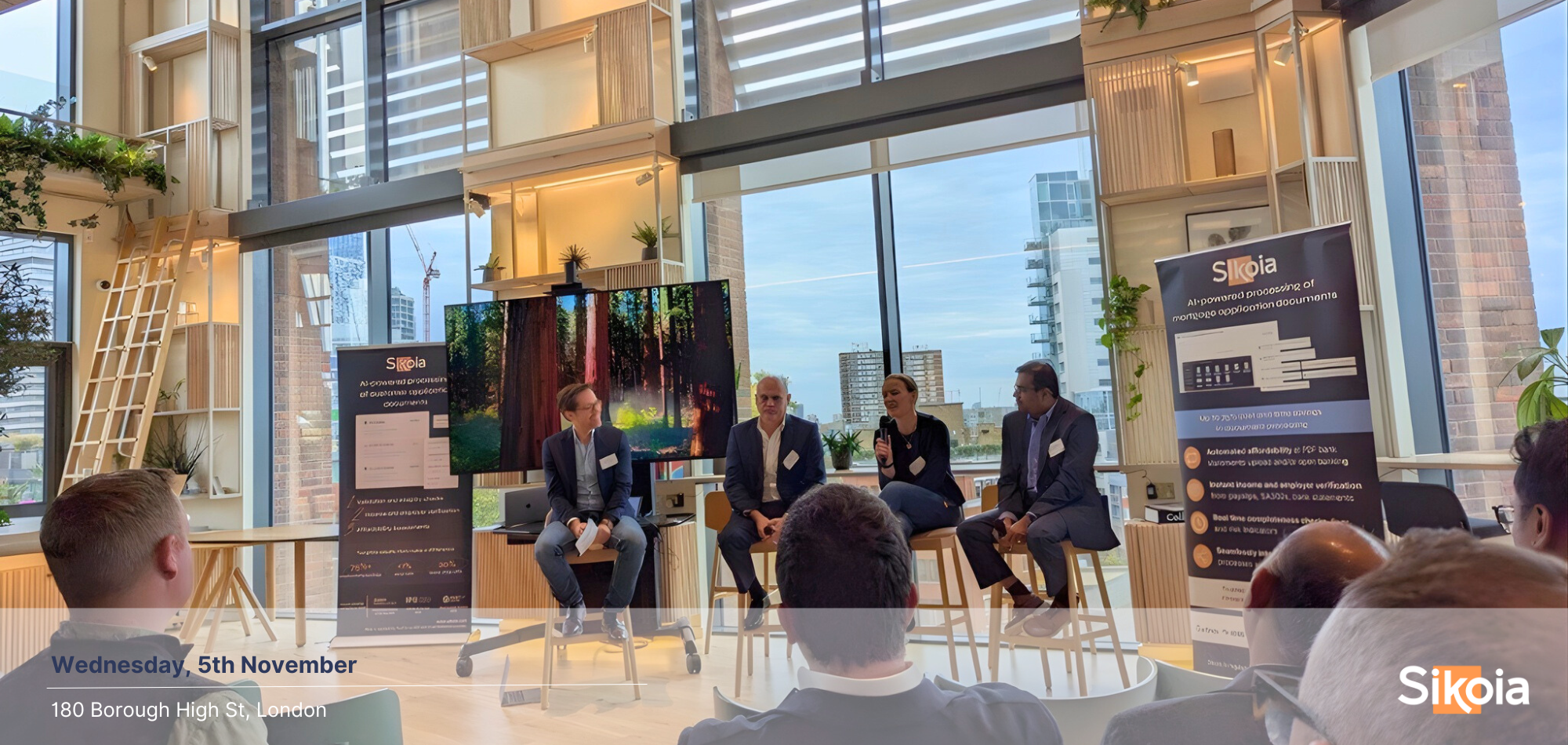
Last week, Sikoia brought together Andrew Lloyd, CEO of Fignum, and Dan Frodsham, Chief Operating Officer at Finclusion, to explore where these assumptions are breaking down and what better looks like in practice. Here are the themes that came through most clearly.
The industry stopped underwriting individuals
Twenty years ago, lending decisions were made person by person. An underwriter would sit with a borrower, review their documents, and make a judgement call. It was slow, expensive, and hard to scale, but it was specific.
As volumes grew, lenders systematised. Scorecards replaced conversations. Credit bureau data replaced bank statements. Decisioning engines replaced underwriters. And individuals were replaced by cohorts.
"We stopped underwriting the specific individual and clustered them into profiles. There is only so much flexibility you can get from a scorecard built on historical assumptions." Andrew Lloyd, Fignum
The efficiency gains were real. But so were the blind spots. When you make decisions based on what a customer looks like statistically, rather than what their actual financial situation is, you introduce systematic error. That error is now being exposed.
Non-prime is not a risk profile. It is a catch-all.
One of the clearest problems the webinar surfaced is how poorly defined the non-prime segment actually is. As Andrew pointed out, the label covers an enormous range of real financial situations, from a senior executive who has just relocated from overseas and has no UK credit history, to someone with multiple county court judgements and a history of missed payments.
Treating these as equivalent is not just imprecise. It is costly. It pushes creditworthy customers out of the market and concentrates risk in ways that do not reflect reality.
"Non-prime does not do us any favours as an industry. We need to segment that further and ask: what do these customers actually need, and how do we serve them correctly?" Andrew Lloyd, Fignum
Dan echoed this from the lender side. Finclusion was built specifically to serve non-standard borrowers: the self-employed, those with complex income structures, customers who have had a life event that disrupted their credit file. The challenge is not that these customers are higher risk. It is that traditional models struggle to assess them accurately.
That distinction matters. Confusing complexity with risk leads to mispricing. And mispricing has consequences for both customers and lenders.
Affordability is still the weakest link
If there is one area where the gap between regulatory expectation and lender practice is most visible, it is affordability.
The FCA's position has shifted significantly. It is no longer sufficient to ask whether a customer can afford a repayment today. Lenders are now expected to evidence whether that customer will be able to afford it going forward, and to demonstrate how that assessment was made. Self-employed income, variable earnings, benefit recipients, gig workers: each requires a different approach, and each creates potential for inconsistency if the process is not well designed.
Dan described Finclusion's approach as drawing on three sources simultaneously: ONS statistical data, open banking, and a direct income and expenditure assessment. Using multiple inputs does not guarantee accuracy, but it creates a richer picture and a more defensible decision.
"The regulator was really keen on affordability protocols. It is not just about whether they can afford it now. It is about whether there is a reason they cannot afford it in the future." Dan Frodsham, Finclusion
Andrew made the same point from the platform side. For super-prime customers, ONS benchmarks are adequate. But as you move down the risk curve, the quality and specificity of affordability evidence becomes increasingly important. Open banking data, where available, provides actuals rather than assumptions. The challenge is that customers often have multiple accounts, and open banking does not always capture the full picture.
There is no perfect solution. But the direction is clear: lenders who rely on averages when actual data is available are building decisions on a weaker foundation than they need to.
Automation has not fixed the problem. It has scaled it.
The promise of automation in lending was straightforward: remove human bias, increase consistency, reduce cost. In practice, the results have been more complicated.
When automation is layered over a decisioning model that was already making imperfect assumptions, the outcome is not better decisions. It is the same imperfect decisions, made faster and at greater scale. Andrew described this as one of the industry's less examined problems: the adoption of technology has not always been accompanied by an honest assessment of whether the underlying model was sound to begin with.
Finclusion's approach illustrates what a more thoughtful version of automation looks like. Technology handles the data collection, categorisation, and initial analysis. AI tooling guides human underwriters through a consistent review process, reducing the scope for individual interpretation. But the human element is not removed. It is redirected toward the cases where it actually adds value: complex income structures, edge cases, situations where the data alone does not tell the full story.
"Consistency is key. If you are not giving consistent outcomes, it is not right by the customer, and it is not right as a business." Dan Frodsham, Finclusion
The goal is not to eliminate judgement. It is to make it more disciplined and more auditable.
The decline journey is broken and no one talks about it
One of the sharper observations from the discussion came from Andrew on the subject of declined applications. When a lender declines a customer, what happens next? In most cases, the answer is not much. The customer is told no and left to navigate the market on their own.
But a decline from one lender does not mean a customer is uncreditworthy. It means they do not fit that particular lender's risk appetite, pricing model, or criteria. A different lender might approve the same customer at a slightly higher rate or with different terms. The problem is that no one is actively bridging that gap.
Building a more effective decline-refer journey, one that routes customers toward lenders who might genuinely be able to help them, is both a fairness issue and a commercial opportunity. It requires lenders to share more about their criteria and it requires brokers and technology providers to connect the ecosystem more effectively. But the appetite for it exists. The infrastructure does not.
What comes next
Andrew ended the session with a view on where the industry is heading that is worth taking seriously.
In the next few years, the way people apply for credit is likely to change. AI-driven tools are already capable of helping customers identify the most appropriate finance product based on their circumstances. As open finance matures and connectivity between financial systems improves, the application journey will increasingly begin outside the lender's own platform.
Lenders who have invested in flexible, data-rich decisioning infrastructure will be better placed to participate in that future. Those still running on legacy models will find it harder to adapt.
The quiet reset is already underway. The question is whether lenders are moving quickly enough to stay ahead of it.
About Sikoia
Sikoia is an FCA-regulated data and technology provider that helps lenders automate affordability verification and document processing. We work with motor finance lenders, mortgage providers, and credit teams who need richer, more consistent evidence to support responsible lending decisions.
If you would like to understand how Sikoia can support your affordability and decisioning process, get in touch.


.png)




.png)


.png)


.png)


.png)


%20(2).svg)


