Joanne Cole is the co-founder of YAVIA, a fintech built to sit at the centre of the adviser-client relationship, connecting the digital and the human in a way the industry has long struggled to do.
In this conversation, Joanne shares how a career pivot, a brother with a software background and a pandemic all played a part in building one of the more interesting propositions in the protection and mortgage space. We also dig into what their partnership with Sikoia looks like in practice, and why Joanne believes the next big shift in adviser workflows won't come from any single tool, but from smarter orchestration.
-
Joanne, can you share your journey into fintech and proposition design, and what inspired you to build YAVIA?
My journey into fintech was quite accidental, to be honest. I came from a background in education. I'm a qualified teacher, and I spent time doing data analysis and digital transformation in that industry. Then I fell into a role at a mortgage adviser's office, focusing on client data and the protection side of the business. I got so interested that I started training as a protection adviser myself.
What struck me was that there were no systems genuinely built to help advisers. Lots of compliance tools, plenty of CRMs. But they were designed around what the system needed, not what the adviser or the client needed. And the thing that really stood out was the gap in customer communication. Even five or six years ago, the industry was moving more digital. People were using banking apps, new fintechs and insurtechs were emerging, and I kept asking: how are advisers going to compete with rising customer expectations? That question was the seed for YAVIA.
My brother is a software developer, so we started building something together, initially just for my own practice. It wasn't really meant to go any further. Then COVID hit, it grew legs, we got funding, and here we are.
What gap in adviser-client engagement was YAVIA built to fill?
The core gap was the absence of any system that put both the adviser and the customer at the centre of the relationship. Most of the existing platforms were actually designed to push the end consumer towards other mobile applications, which effectively removed the adviser from the journey altogether.
YAVIA was built to fill that space: keeping the adviser present and engaged throughout the client journey, while making the whole experience more digital, more efficient and more human at the same time.
YAVIA sits across the adviser and client journey as a layer above existing systems. How have customer expectations around digital interaction changed?
Customers have always been moving in this direction. I could see it years ago, and it's what pushed me to start building. But what's shifted dramatically in the last 12 months is the adviser side catching up.
For a long time, one of our biggest barriers was adviser resistance. We always did it this way. The network asks us to do it this way. That's changed noticeably. Advisers are now coming to us having done their own research, saying they want to embrace the tech. They understand the industry is changing and they want tools they can plug into and actually use.
On the customer side, expectations are clear: they want instant communication, they want to know exactly what's happening at each stage, and they want to feel educated and informed throughout. And that doesn't matter if you're 20, 40 or 80. My mum uses her banking app every day. That's the baseline now.
You're now partnering with Sikoia to streamline document verification and processing. In your view, what are the most valuable ways automation and AI can enhance adviser workflows without compromising trust or compliance?
The key is building automation into the workflow, not using it to remove the adviser from it. We have a strong example of this in practice. A lot of leads are coming through TikTok now, particularly from first-time buyers. These customers are getting a very personal experience on social media: videos, education, a real sense of who this adviser is. The challenge is carrying that into what happens next.
So when a new client comes into our mobile app, the first thing they receive is a video from their adviser: the same person they saw on TikTok, now welcoming them into the digital journey. That trust is preserved. From there, the journey is pre-configured. Documents get requested, uploaded and run through a processing tool like Sikoia. The adviser doesn't have to chase anything manually, and the client doesn't feel like they've been handed off to a faceless system.
The goal is to maintain that personal touch throughout the digital platform, while still delivering the operational efficiency that makes the business scalable.
What impact does early document automation have on the onboarding process, compared to more traditional approaches?
The difference is significant. We work with an adviser, Marnie McGee, who advocates for what she calls a “DIP in a day”: getting to a decision in principle within a single session. That's now achievable because the information comes in through the app, gets uploaded to Sikoia, the data is extracted, and she has what she needs in seconds rather than hours.
And it's not just about speed when things go smoothly. When a client can't get a DIP, she knows earlier, which means she can go back with a clear plan: here's what you need to address, here's how we move forward. The earlier automation sits in the journey, the faster the answer comes, in either direction.
For firms considering similar integrations, what advice would you give about choosing the right partners?
Build the relationship before you build the integration. What we did with Sikoia was take the time to understand the product, narrow down the pain points and test it properly with our beta customers before it went anywhere near the market. By the time it did, we knew it worked.
That matters because there will be edge cases: documents that don't read cleanly, integrations that need refinement. If you've built trust with your partner and you're working together to solve those things, they don't become blockers. If you haven't, they do.
Choosing the right technology partner isn't about finding the most feature-rich product. It's about finding a partner you can work with, trust and build with over time.
Where do you see the biggest opportunity for data-driven decision-making in adviser workflows, across mortgages, protection and cross-sell journeys?
We talk a lot about the “next best action”, and I think this is the biggest opportunity in the industry right now. We've never been in a better position to use the data we hold for meaningful, proactive engagement with customers.
The problem is that most data sitting in adviser platforms is static. It's there, but it's not going anywhere. It might be 15 or 20 years old. Data that old isn't going to drive good decisions.
What YAVIA advocates for is regular, fresh data collection, so you can pick up signals. Has this client had a baby? Are they looking at moving house? Are there gaps in their protection? That orchestration layer, sitting between the customer engagement tool and the back-end systems, is where AI plays such a powerful role. It's not a one-and-done relationship. It's ongoing, data-driven and genuinely useful to both adviser and client.
Tech adoption in financial services is still uneven. What do you see as the biggest blockers, and how does the industry move past them?
A few things have held this back: legacy systems that don't integrate easily, suppliers who promise to build their own rather than open up their APIs, and then don't, and advisers who've simply always done it a particular way, because the network said so and the process was set.
But I think the biggest blocker is change management. Not the technology, the people. Changing a process is painful, nobody's saying it isn't. I know that first-hand, even within YAVIA as we've grown. And you need real commitment from the whole firm, not just one enthusiastic person, or the implementation stalls.
The firms seeing the best results from tools like ours are the ones where everyone has bought in, where the adviser, the admin team and the firm owner are all using it and reinforcing it. The ones who've implemented partially are seeing partial gains. It's as simple as that.
Looking ahead 12 to 24 months, where do you think we'll see the most meaningful change: in client engagement, data orchestration, or decision-making?
I think the biggest shift will be in how the orchestration layer evolves. We'll see more organisations building engagement layers that sit above the CRMs, the policy systems and the quoting engines, collecting customer signals, coordinating journeys and delivering the next best action across the client lifecycle.
AI will be a powerful enabler of that layer. But the real value won't come from AI alone. It will come from combining trusted data, the adviser relationship and human expertise, and keeping the human in the loop throughout. The firms that get that balance right will have a significant advantage.
And finally, what's one lesson you've learned about scaling innovation in a regulated environment that others should know?
Start with the outcome, not the technology.
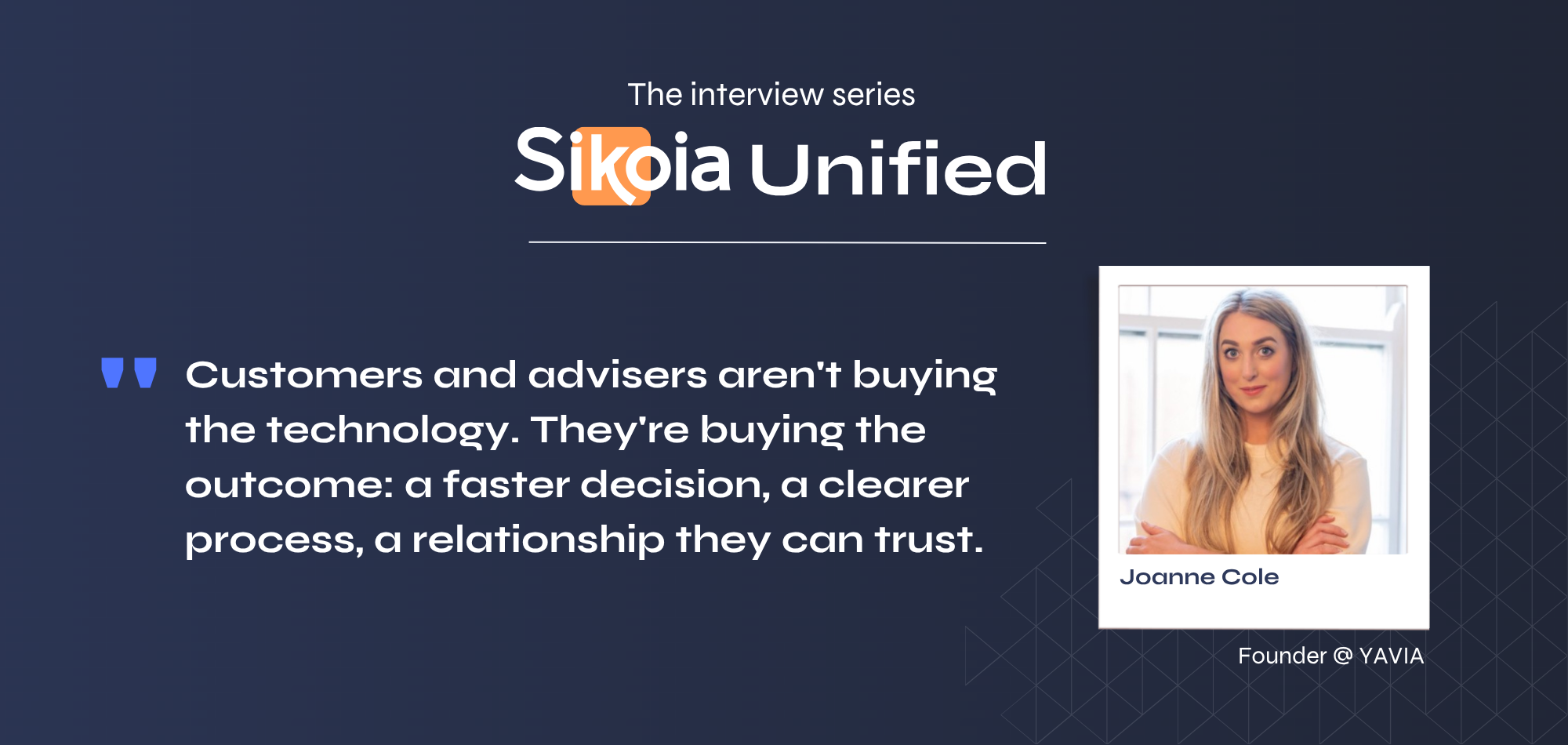
It's so easy to get excited by AI, by automation, by new capabilities, and lose sight of what you're actually trying to achieve. But customers and advisers aren't buying the technology. They're buying the outcome: a faster decision, a clearer process, a relationship they can trust.
The most successful innovators will be the ones who make the adviser's life easier, improve the customer experience and strengthen compliance through the quality of data they hold. Trust is what makes all of that possible. And when you have it, innovation becomes much easier to scale.
-
Sikoia turns customer documents into verified, decision-ready evidence in seconds, so advisers, brokers and lenders spend their time on the conversation rather than the admin. To see what that looks like in your workflow, book a call here.



.png)


.svg)


.png)


%20(3).svg)

