

Interview
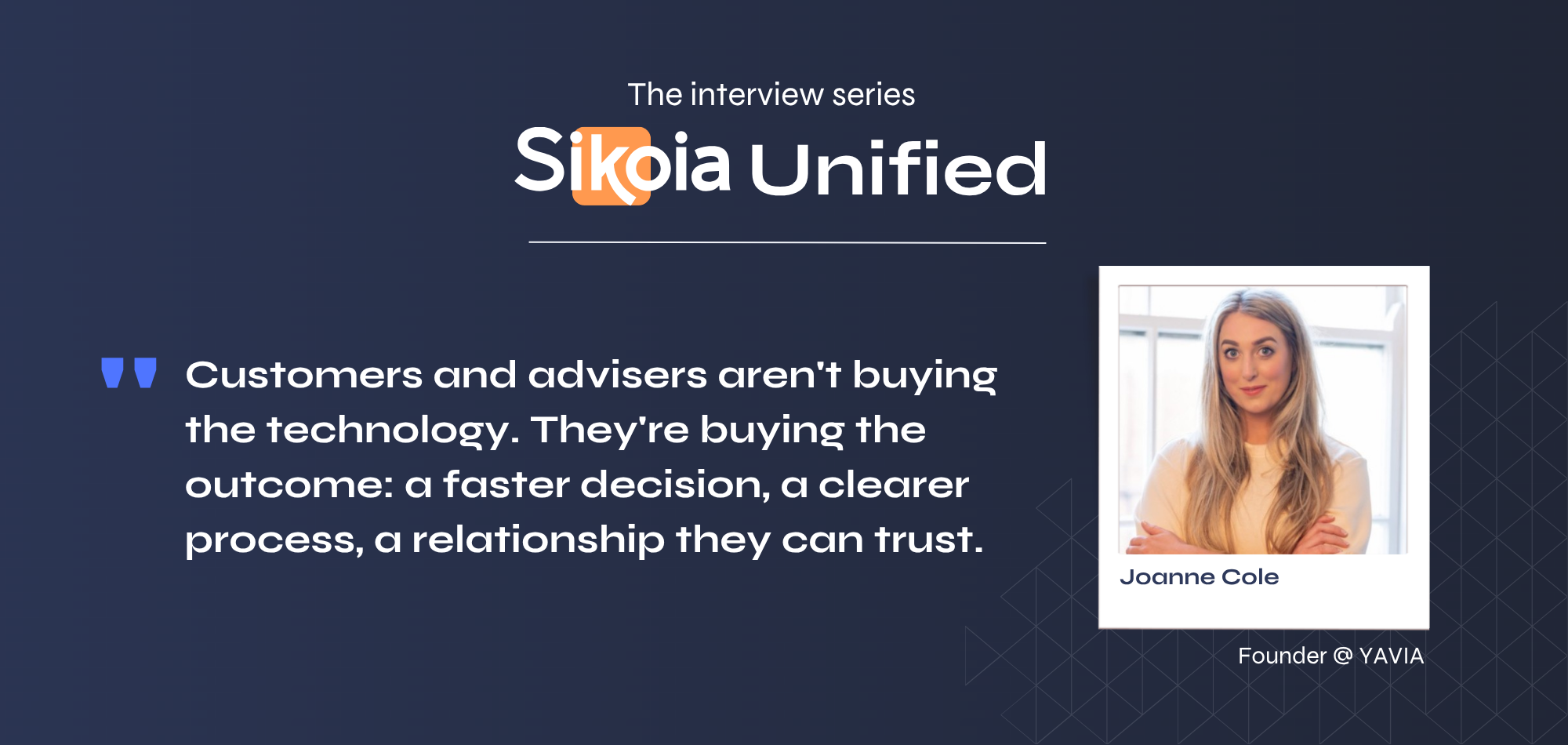
Sikoia Unified meets Joanne Cole
Most adviser platforms were built around what the system needed. Joanne Cole built YAVIA around what the adviser and the client needed.
The mortgage industry is under pressure to deliver faster, more digital experiences while preserving the human touch. Craig Brown, Chief Mortgage Officer at Bath Building Society, discusses how mutual lenders are navigating that balance.


Welcome, Craig. You've worked across mortgage operations and underwriting for over two decades. What are some of the key shifts you've seen in how lenders approach customer experience and operational efficiency?
In my time in the industry, I've worked predominantly for non-mainstream lenders, smaller ones that rely on more manual processes and underwriting. I'd say I've only noticed a significant change over the last five or six years, particularly since COVID. That forced all of us to change the way we work and rethink things. Paper files don't mix particularly well with hybrid working, so everything has to be digital nowadays. You might think surely five years ago everything was digital, but believe me, for us and for quite a lot of small lenders, it wasn't. Paper was still king. Lockdown happened, and it was a real wake-up call.
Certainly here at Bath, we recognise we can no longer rely on just our niche criteria and great customer service. We've got to combine those with a slick digital journey for customers and brokers alike. Five years ago, I couldn't have told you what our application-to-offer average number of days was, whereas now we're constantly monitoring it. How we can reduce it, reduce the number of touchpoints, speed things up, make the journey slicker. Leveraging new technologies like the Sikoia platform to semi-automate or fully automate processes for underwriters and operations teams is where we need to go.
We're not looking to replace people, but to aid them. Present relevant information instantly rather than having to trawl through bank statements and so on. People's expectations have risen, and they expect everything quicker nowadays.
At Bath, you're now leading mortgage strategy during a time of rapid change in the industry. How are you thinking about balancing traditional service values with modernisation and transformation?
Our main aim is to grow. For us as a small society, to safeguard our future we need to increase our size. We're not looking to adopt tech to reduce our headcount, but instead support colleagues and make them more productive with those new technologies. We're investing heavily in new systems and transforming our digital experience, but we really do want to remain grounded with our people. The area of the industry that we're in doesn't necessarily align with straight-through processing and full automation. That's for the high-street lenders.
What we do need to do is make our business slicker, faster, easier for people to deal with, whilst still retaining that human touch. We have three strategic pillars, the first one is "digital first, always human." We absolutely want to adopt digital processing where it adds value, but always retain that human element.
As someone who's worked in both mainstream and mutual lending environments, how would you compare the way building societies approach innovation and change compared to larger, more centralised institutions? What feels like an advantage, and where does it create unique challenges?
Due to the nature of smaller teams, the mutual sector in general leverages innovation from third parties rather than having our own in-house teams to develop new functionality. Some suppliers tend to have a concentration of clients in our sector, so they pool resources, and we can benefit from reductions in cost as a result.
As far as change is concerned, in large institutions, there's greater governance, which often leads to slower decisions and implementations. In smaller organisations like ours, we can benefit from that agility. We've got fewer layers of decision-making to navigate and much more agile approaches to budget management.
Probably the biggest challenge is the limited in-house resource we've got. Trying to balance business-as-usual with the change programme really can be a stretch. It pulls your people's time. It's great if you can concentrate on transformation for a year and almost turn off the business, but we're not in a position to do that, so it really is about finding that balance.
Bath Building Society is known for its hands-on, member-first approach. As you evolve your tech stack and processes, where are you seeing the biggest opportunities to improve speed and service without losing that human touch?
Our biggest opportunity is APIs. Currently, you wouldn't believe how manually we do things. None of our systems talk to each other. But we’re currently onboarding a new origination platform with OMS, which will introduce no less than 15 APIs to remove those manual tasks of fetching data, sending data, and re-keying data. That's going to free up people to do more value-added tasks, like speaking to brokers and customers, answering the more complex queries.
We take our feedback from members and brokers very seriously. What we've heard for years, and still get now, is that brokers absolutely love our products, they love our people, but they find us slow. So it really is a case of combining what we've already got with more user-friendly systems and faster processing.
There's been a real push across the industry to streamline how lenders collect, verify, and process customer information. How are you approaching that challenge, particularly when it comes to improving underwriting inputs and reducing friction for brokers?
The first step is the introduction of the new origination platform with OMS and all the third parties it's going to link with. That will allow brokers to digitally submit DIPs and applications, upload supporting documents, download offers, streamline the process for them, and get real-time updates. We'll be bringing in automated criteria rule checking, credit & ID checks, which will all take place at DIP, instantly highlighting any concerns and raising additional requirements, rather than waiting for manual assessment.
I’m really excited about the introduction of Sikoia’s document reading capability. However, underwriters, by their very nature, are quite suspicious creatures, so they've really got to believe in this, believe that the system can do the job at least as well as them if not better, otherwise, they're not going to buy into it.
The proof-of-concept we're going through with Sikoia has been brilliant because it allows the underwriters, before we go live with a full integration, to gain that trust in what Sikoia can do. It's not threatening their job. It's going to help, save them the manual, horrible task of scrolling through and interpreting payslips and bank statements for hours on end. That functionality is also going to bolster our fraud defences.
What are the typical pain points you see in the underwriting journey today, and how are you thinking about solving them through better data, automation, or process design?
The biggest pain point for underwriters here is the collation of that data. It's really time-consuming, particularly because we don't deal with very many standard cases. When you're looking at complex applications, portfolio landlords on a limited company buy-to-let portfolio, for example, or a self-build application, the sheer volume of documents that need assessing can be huge. It's a really slow, arduous process for us, but also for the broker and ultimately the customer. To have a tool like Sikoia there to do that heavy lifting and just present the data back in a quick, digestible format for the underwriter to process, it could be game-changing for us.
We've been excited to partner with Bath as part of that transformation journey, helping automate parts of the document handling and verification process. From your perspective, what's the real value of these types of integrations, and how do they support the broader shift in how lenders operate?
The real value is speed and time saved. On those more complex cases, I envisage the use of Sikoia could cut the underwriting time by up to 50%. The knock-on effect is that brokers and customers get their decision much quicker, so it's great for them.
For us, it means our people spend less time per case, creating the additional capacity we need to grow the business without massively increasing headcount.
Also, fraudsters are getting smarter. They're making it far harder for humans to identify fake documents by sight. Sikoia can be integral in validating document integrity and giving us that extra layer of security in the never-ending fight against fraud.
When you're assessing potential tech partners, what makes a provider stand out, not just in terms of product capability, but in their ability to work with your team and embed change effectively?
We're a small society and don't have great reams of resources to throw at change. What we're finding on this transformation journey is that in some cases, it's beeficial to deal with suppliers who've been around and delivered their product multiple times, largely off-the-shelf, having learned from previous implementations. We’re trying to be as innovative as possible and adopt the latest tech, but we don't have the depth of resources to be guinea pigs. We're partnering with around a dozen new suppliers, some newer entrants, some more established. It's a good balance.
Looking across the full mortgage journey, from decisioning and case packaging to underwriting and post-offer workflows, where do you see the most ripe opportunities for smarter automation or better use of structured data?
For us, it's right through the journey. We're starting from a low point, in all honesty!
As an industry, automated decisioning is quite well established, helped by the evolution of credit reference agencies that now provide current account turnover, affordability models, and new data such as rental payment history and utility records.
For us in particular, but across the industry, packaging is where we could see the next big gain, replacing manual checking of supporting documents with AI will be significant. Not just reading the payslips and bank statements for the underwriters, but actually stopping the case from progressing past submission where there are missing or incorrect documents. Brokers will try tricks to submit cases faster, like uploading blank pages or duplicate documents, but ultimately, that just causes downstream delays, so if AI can prevent that, let’s adopt it.
Finally, what advice would you offer to other mutuals or specialist lenders who want to modernise without losing what makes their service model unique?
My key piece of advice for our sector would be to stay grounded. Once you start this transformation journey, it's really easy to get carried away with what can be done rather than what suits your business. I'll be honest, I've been a bit like a kid in a sweet shop over the last 12 months. It's tempting to say we’ll have that, or automate this, and so on, but ultimately that's not our place in the market. It's not who we are, and it's not what our brokers want. We really need to utilise the new technologies to be faster, more efficient, easier to deal with, but always to complement our people and the products we've already got, rather than replace them. That would be my key
Sikoia Ltd is authorized and regulated by the Financial Conduct Authority (FCA) as an Account Information Service Provider (AISP) under the Payment Services Regulations 2017 (FRN: 942979) and as a credit reference provider (FRN: 942616). Sikoia Ltd is a credit broker and not a lender. Credit is subject to status.


.png)


.svg)


.png)


%20(3).svg)
