

Interview
Sikoia Unified meets Joanne Cole
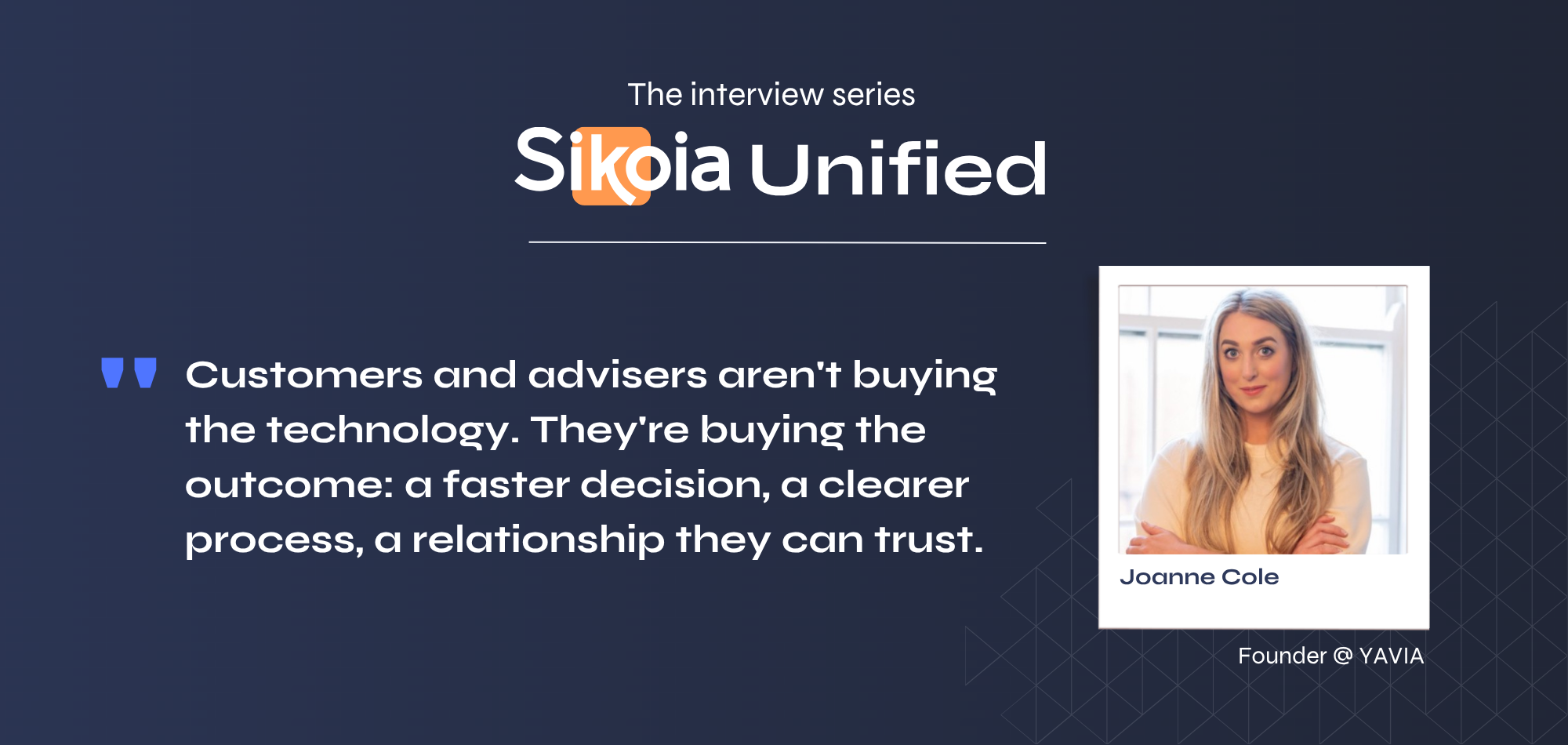
Most adviser platforms were built around what the system needed. Joanne Cole built YAVIA around what the adviser and the client needed.
In this interview, Chris Bosworth, CEO of Finclusion, talks candidly about how the UK motor finance market is evolving, what good customer outcomes really look like, and how technology and responsible underwriting can open access to credit for customers who’ve been overlooked.


Chris, thanks so much for taking the time to sit down with us. Since partnering with Finclusion, we’ve had a front-row seat to how thoughtfully you’re approaching non-prime car finance, from affordability and decisioning through to genuinely better customer outcomes. We wanted to use this conversation to dig into how the market is changing, where technology is really making a difference, and what it takes to serve complex customers responsibly, without oversimplifying the reality.
To kick off, can you tell us from your perspective, how has the UK motor finance market changed over the past five years, particularly for non-prime and financially vulnerable customers?
It’s changed quite a lot, and probably not in a way people always expect.
If you go back six or seven years, there was a real wave of new entrants into the near-prime space. They brought more automation, more data, and more sophisticated underwriting. In simple terms, they showed that you could run these models far more efficiently than the market had been used to.
What happened next is fairly predictable. Those new models started attracting the stronger customers who might previously have gone to traditional subprime lenders. Over time, those traditional lenders followed them up the credit spectrum. Automation made near-prime more profitable, funding became easier to access, and securitisation started to make more sense.
The knock-on effect was that true non-prime customers were gradually left behind. That’s the gap that’s really opened up over the last few years. What’s interesting now is that technology has caught up. You can apply the same automation and decisioning discipline people expect in near-prime, but use it to serve non-prime customers properly rather than excluding them.
What’s the biggest misconception about serving customers outside the prime lending segment?
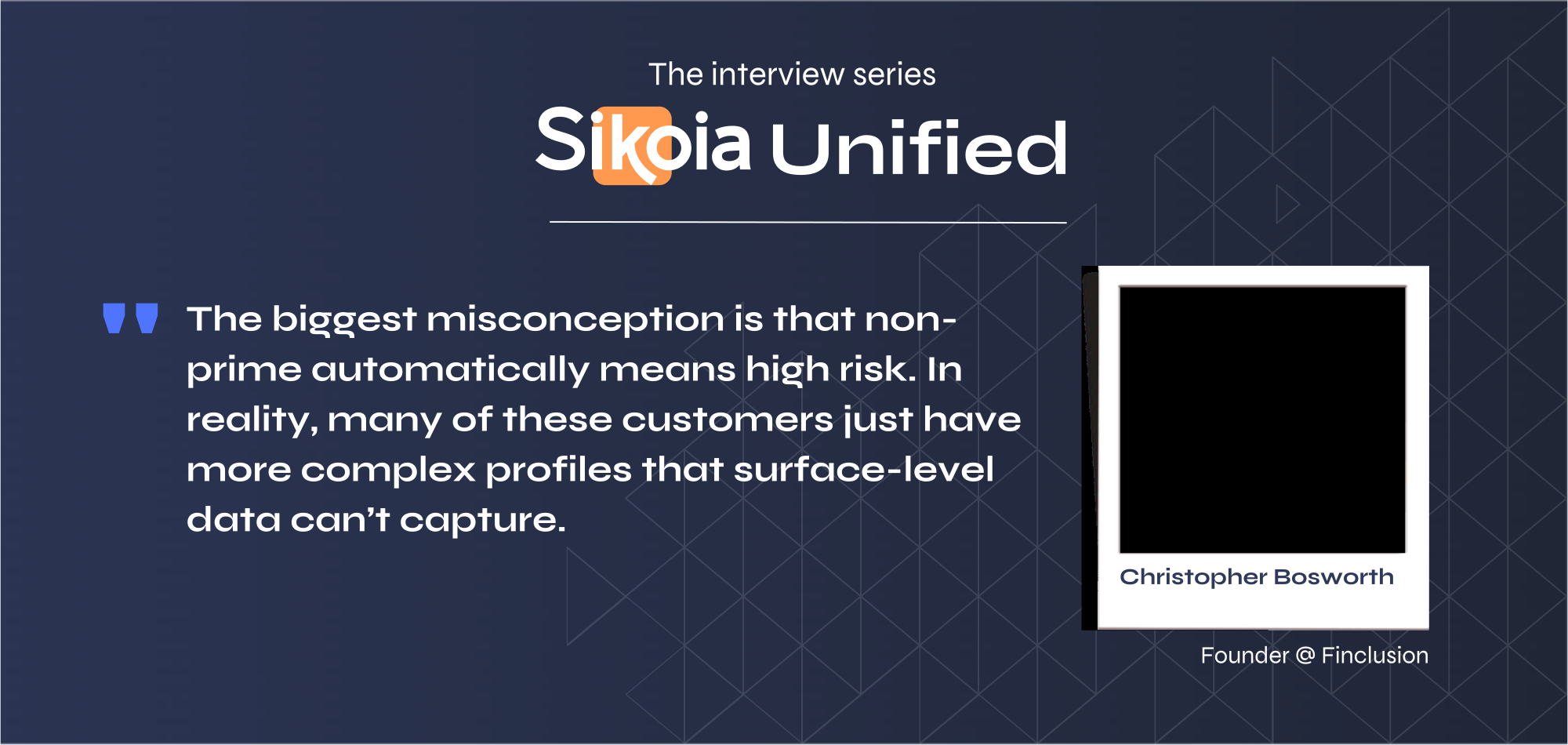
The big one is the assumption that non-prime automatically means high risk.
In reality, that’s often not true. Most of the customers we see aren’t reckless or unreliable. They just don’t fit neatly into traditional models. Their situation is more complex, and complexity is often mistaken for risk.
From my perspective, underwriting in this space really comes down to four core components.
You’ve got the customer’s credit profile, their affordability, the dealer the vehicle is coming from, and the vehicle itself. Every finance decision is some combination of those four things. In prime lending, if just one of them isn’t quite right, that’s often an automatic decline. In near-prime, one or two issues might still lead to a rejection.
What we’re trying to do is get comfortable across all four, rather than judging each one in isolation.
And that links to what I think is the biggest misconception about non-prime lending. There’s an assumption that anyone outside the prime segment is bad credit. In reality, that’s often not true at all. Many of these customers simply have more complex needs that aren’t easy to assess using surface-level data.
That complexity can come from different places. Sometimes it’s the vehicle itself, maybe it’s older or has characteristics that make it harder to underwrite. Often it’s affordability. People might be self-employed, working in the gig economy, or new to the country. And on the credit side, you can have situations like financial abuse, where someone’s credit score has been damaged even though their underlying risk today is actually quite low.
At face value, the data can make these customers look high risk, which is why prime and near-prime lenders tend to turn them away. But when you understand the full story, that often isn’t the case. Done properly, non-prime lending is really about identifying customers who aren’t actually high risk, even if their surface-level profile suggests they might be.
Finclusion talks a lot about improving access to credit. What does a “good customer outcome” actually look like in car finance?
One of the reasons we focused on car finance is that it’s very tangible.
A car isn’t abstract credit, it’s mobility. For a lot of people, having a reliable car genuinely changes their day-to-day life. It can mean being able to take a better job, reduce the stress of constant repairs, or simply have more certainty around monthly costs.
That’s very different from unsecured credit, where the money might be spent on something short-term and leave the customer no better off. When you’re funding an asset that clearly improves someone’s situation, it becomes much easier to think about lending in terms of positive outcomes rather than just risk avoidance.
Which part of the lending process is still the hardest to get right?
Affordability is the big one.
Credit bureau data has improved massively over the last decade. Vehicle data has too. But affordability hasn’t moved at the same pace. People’s finances are messy, especially in non-prime, and it’s hard to capture that properly without doing real work.
Things are improving, particularly with better data sources and digital tools, but affordability still needs the most judgement. For us, that’s also where we choose to spend our time, because it’s an area most large lenders don’t want to touch in depth.
How do you think about responsible lending when customers have complex financial profiles?
For us, complexity on its own isn’t a red flag.
What it really means is that you need to slow down and understand what’s actually going on. We do a full income and expenditure assessment for every customer. That’s not something a high-volume lender could realistically do, but it’s essential for the segment we’re serving.
We try to make that process as automated as possible, but not at the expense of nuance. The aim isn’t to remove judgement, it’s to support better judgement with better information.
Regulation has become a major focus, particularly with Consumer Duty. How should firms think about this beyond basic compliance?
I think the industry’s biggest mistake historically was letting complexity spiral.
Structures became so complicated that even people working in the industry struggled to explain them clearly, never mind customers. Once things get that opaque, trust starts to disappear.
Our approach has been to keep things simple. Dealers sell cars and earn margin on the vehicle. We make money on the finance. There’s no finance commission paid to dealers. That simplicity makes it much easier to explain what’s happening and why.
Compliance shouldn’t just be about ticking regulatory boxes. It should be about whether a customer could reasonably understand the product and feel comfortable with it.
Many lenders still rely on manual processes and fragmented data. How much does that matter in practice?
It matters more than people sometimes realise.
Historically, underwriting was very manual. That allowed for judgement, but it also created inconsistency. Two different people could look at the same application and reach different conclusions.
Then the industry swung towards rigid automation, which improved consistency but struggled with complexity. What we’re seeing now is a better balance. With richer data, you can replicate human judgement at scale, but do it in a way that’s consistent and auditable.
Fragmented data is usually the root cause of manual work. Fix the data problem, and a lot of operational friction disappears.
As decisioning becomes more data-driven, how important are explainability and auditability?
They’re absolutely critical, especially in regulated lending.
We’re very deliberate about using models that are explainable. For every decision, we can see what drove it and why. That gives us confidence internally and makes conversations with regulators much more straightforward.
There’s a lot of noise around AI, but opaque models are hard to defend. If you already have approaches that work well and can be explained clearly, there’s very little incentive to move away from them.
Looking three to five years ahead, how do you see the non-prime and near-prime market evolving?
Near-prime has already become very competitive, which is good news for customers. Pricing has moved much closer to prime levels.
In non-prime, access is still the bigger issue rather than price. That should improve as more specialist lenders enter the space. Over time, those niches will overlap, competition will increase, and customers should start to see the benefits.
Greater transparency, particularly around commissions, should also help ensure innovation actually benefits customers rather than just intermediaries.
What separates successful specialist lenders from those that struggle?
Clarity and confidence in decisioning are huge.
You need to be very clear about who you’re serving and consistent in how you apply your risk appetite. Growth, credit performance, and funding costs all move together. If one is out of balance, the whole model suffers.
The lenders that understand that relationship tend to be the ones that last.
Finally, what advice would you give to teams trying to modernise their lending process or operating model?
The biggest thing is to start with the process, not the technology.
It’s very tempting to buy a shiny tool and hope it fixes everything. In reality, you need to step back, break the lending journey down, and be clear about what you’re actually trying to achieve.
Once you’ve done that, it becomes much easier to see where technology genuinely adds value. That mindset applies whether you’re building something new or trying to modernise an existing operation.
Chris, thanks again for such a thoughtful and candid discussion. It’s been really useful to hear how you think about complexity, regulation, and the role technology should play in supporting better lending decisions. We appreciate you sharing your perspective, and we’re looking forward to continuing the conversation as the market develops.
Sikoia Ltd is authorized and regulated by the Financial Conduct Authority (FCA) as an Account Information Service Provider (AISP) under the Payment Services Regulations 2017 (FRN: 942979) and as a credit reference provider (FRN: 942616). Sikoia Ltd is a credit broker and not a lender. Credit is subject to status.


.png)


.svg)


.png)


%20(3).svg)
