

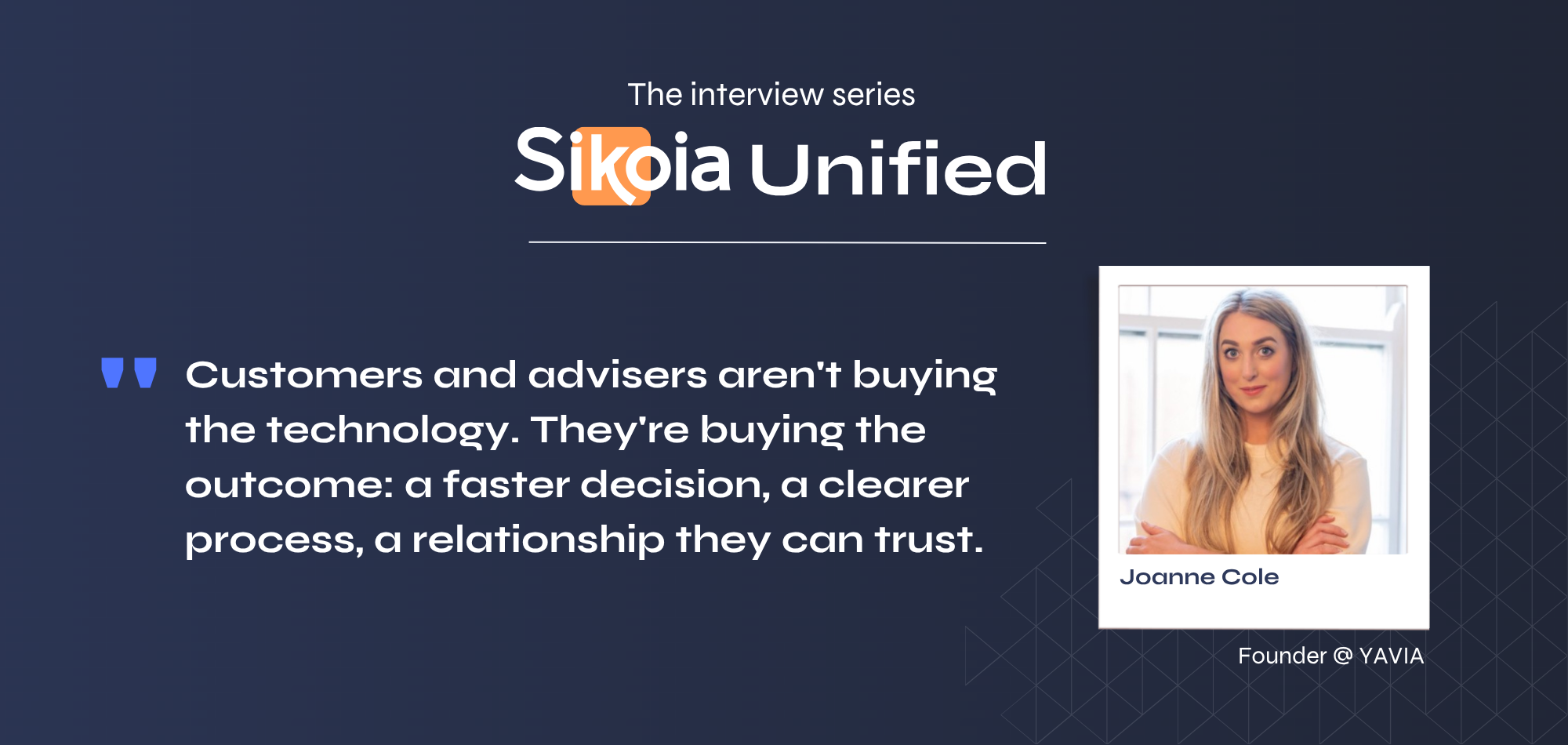
Interview
Sikoia Unified meets Joanne Cole
Most adviser platforms were built around what the system needed. Joanne Cole built YAVIA around what the adviser and the client needed.
Innovation in lending rarely fails because of technology. In this conversation, Lucinda Brown, Product & Proposition Leader, explores the hidden complexity behind lending journeys and why meaningful innovation often comes from improving the fundamentals rather than chasing headline breakthroughs.


Luc, welcome! You’ve moved through consulting, challengers, and proposition leadership. What’s the thread that’s tied your career together?
If I look back, I think I’ve always been drawn to the messy bit in the middle. The point where you have a brilliant idea on paper and then reality quietly raises its hand.
Consulting gave me the tools to structure problems and ask better questions. Traditional banks showed me what scale and regulation really mean - and how much invisible complexity sits behind products that look simple. Challenger environments reinforced something else: if it doesn’t work for real customers, it’s still theory.
The most consistent driver across all of that has been the customer. I am motivated by creating products that reduce load and stress, particularly in financial moments that already carry a lot of emotional weight. Applying for credit or navigating a mortgage isn’t a neutral task. It’s high stakes. If you can design something that feels clearer, fairer and more supportive, that really matters.
So the thread has been about joining everything up - commercial reality, risk discipline, operational practicality. Making sure the whole system works together for the customer, not just technically on paper.
Was there a particular moment that pushed you toward product and proposition strategy?
I realised quite early on that I was less interested in designing individual features and much more interested in how everything connects.
It was never just about one step in the journey. It was about the full chain. The decisioning, the servicing, the controls, the distribution model. Those joins between teams and processes are where things either work beautifully or quietly start to fall apart.
The first time I launched something end to end was a turning point. On paper everything made sense. The logic was sound, the journey looked clean, and the proposition felt strong. Then customers started using it and you could see where it creaked. You could see the moments where people hesitated, where internal teams created workarounds, and where the experience didn’t quite match the intent.
That’s when it clicked for me. The real challenge isn’t designing something in isolation. It’s understanding how all the moving parts behave once they meet reality.
That was probably the moment I knew proposition was where I wanted to spend my time. Fixing the joins, not just polishing the surface.
That’s really intresting. With that in mind, what’s really stopping lenders from adopting tech that would genuinely improve journeys or decisioning?
It’s rarely the technology itself.
Most lenders aren’t resistant to innovation. In fact, most organisations I speak to are actively looking for ways to improve journeys and make better decisions. The reality is that they’re layering new capability on top of processes that have evolved incrementally over years.
Over time, workarounds get introduced, ownership shifts, policy exceptions appear and new controls are added to address real issues or regulatory expectations. None of these things are wrong in isolation. In most cases they were sensible responses at the time. But the result is that you end up with brilliant tools sitting on top of unclear ownership, manual steps and layers of process that were never originally designed to work together as one system.
From the outside, this often gets labelled as legacy systems. From the inside, it feels much more like the natural by-product of running a regulated business for a long time. Organisations are balancing customer outcomes, risk management, compliance expectations and operational reality all at once.
So, when new technology arrives, the real question isn’t whether it works. It’s whether the organisation is clear enough - in its ownership, policy and operating model to use it effectively.
Is there a blocker that people on the outside tend to underestimate?
How much invisible complexity sits behind something that looks simple.
From the outside, a lending journey can appear very straightforward. But internally, it reflects years of iteration and risk management. Every time something has gone wrong, or expectations have shifted, a new control has been added. Most of those decisions were sensible at the time and designed to protect customers and the business.
Over time, though, those layers accumulate and create friction. Processes become more interconnected, ownership becomes more distributed, and change becomes harder to implement.
That invisible complexity is often underestimated, and it’s a big reason transformation takes longer than people expect.
You mentioned both technical and organisational strains, do you find the bigger challenges are technical or more about culture and ways of working?
They are deeply intertwined.
You can have a team full of smart, motivated people who want to innovate, but if the architecture cannot support the ambition, you hit a ceiling very quickly. Equally, you can modernise technology and still move slowly if decision making is fragmented or siloed.
Real progress happens when product, risk, operations and engineering shape the problem together from day one. Not in sequence - not Product first, then Risk review, then Operations clean-up. Genuinely together.
I saw a great example of this in recent transformation work. Developing propositions genuinely involved teams across the business, asking probing questions, challenging assumptions and being open to trying new approaches.
Some of my favourite moments were when Legal, Finance or Data teams would stand up and advocate for the proposition. Not because it was “product’s idea,” but because they felt ownership. That’s when you know culture and architecture are starting to align.
You’ve said before that new doesn’t always mean useful. In lending, what does meaningful innovation look like to you?
It’s usually not about headline breakthroughs - it’s about improving the fundamentals.
For me, meaningful innovation improves decision quality, removes avoidable friction or makes something clearer for the customer. Ideally, it does all three. It doesn’t have to look revolutionary. Often it looks like simplification or removing steps that no longer add value.
If it doesn’t reduce cost, reduce uncertainty or reduce effort, it’s probably not adding as much value as we think.
AI underwriting is a good example of something that can be over-hyped. AI can absolutely help, but it amplifies whatever sits underneath it. If the data is inconsistent or the policy logic is unclear, you end up with faster confusion rather than better decisions. The foundations matter more than the headline technology.
From your experience, what role do ecosystem partnerships play when lenders are trying to accelerate change or improve customer journeys?
Partnerships can be incredibly powerful but only when both sides are clear on what kind of relationship they’re building.
Are you looking for a capability provider, a delivery partner, or a true strategic partner who will challenge you and co-create? If that isn’t explicit upfront, frustration creeps in quickly.
During transformation, you’re often exploring new territory. The most valuable partners don’t just deliver against a brief, they challenge it.
One of the things I really appreciated working with Sikoia was the proof-of-concept approach. It wasn’t just about delivering a capability; the team came back with insights we hadn’t even considered, which broadened the internal conversation.
The best partnerships start with a deep understanding of the customer and the outcome you’re trying to achieve. They ask questions, bring ideas and help you think differently. That’s the difference between execution and genuine partnership, and it’s where the real acceleration happens.
Looking ahead, where do you see the most realistic opportunities for quick wins?
Honestly, simplifying what already exists.
There is huge value in improving decline journeys, tightening affordability logic, reducing rework loops and making onboarding genuinely smoother rather than just cosmetically digital.
We sometimes get excited about launching something new, but there is often more value in quietly removing friction from something that already works.
Interesting, any particular segments or journeys ripe for change?
Self-employed borrowers and people with complex income stand out immediately.
Manual judgment is still doing much of the heavy lifting here. That isn’t inherently wrong, as human judgment has historically been how lenders manage uncertainty, but it does create friction. Cases take longer, processes become more cautious, and viable applicants can fall out simply because their income is harder to interpret.
This is where structured, data-driven decisioning becomes powerful. With richer, verifiable insight into income stability and financial behaviour, lenders can move beyond blunt averages and manual workarounds.
The opportunity isn’t just automation, it’s precision. Better insight allows lenders to approve customers who might previously have been declined, without increasing risk. That’s commercially attractive and improves access in a responsible way.
Non-prime lending makes this particularly clear. There are still large groups of customers who are underserved because traditional models rely on narrow data signals. Expanding how we interpret income and affordability creates a genuine competitive advantage.
The shift is from manual interpretation and blanket conservatism toward structured decisioning that is both fairer and more commercially effective.
Lenders sit on huge amounts of data. Where could they use it better?
Data is not usually the problem. What is often missing is a clean thread between data, policy, decision and outcome.
Income stability is a great example. Many lenders still focus on headline income rather than volatility over time. Using open banking data to assess predictability instead of just averages can materially improve both risk accuracy and fairness.
Another overlooked area is broker analytics. Looking at rework patterns, document quality and incomplete submissions can surface where processes are genuinely breaking down. Completeness checks could make a real difference here. Rather than tightening processes for everyone, we could focus on changes where they are actually needed or even reward brokers who consistently submit high-quality, complete applications.
Have you experimented with AI or LLMs in proposition or decisioning work?
I am genuinely interested in AI, but I try to stay pragmatic. It’s broad in where it can add value, but it shouldn’t become the strategy. It has to serve a clearly defined customer or operational need.
The most useful applications I have seen so far are relatively simple. Speeding up analysis, summarising research, and generating structured hypotheses. It augments thinking rather than replacing it.
One area I’m particularly excited about is using AI to deepen empathy within product teams.
For example, synthetic personas that teams can actively interact with throughout the development cycle. Not everyone can sit in on research sessions or customer interviews. If AI can democratise access to real customer insight and make it part of everyday product decisions, that’s incredibly powerful.
As AI becomes more embedded, how do you balance innovation with transparency?
My rule is simple. If you can’t explain it clearly, you shouldn’t deploy it.
Regulators don’t expect perfection. They expect transparency, monitoring and control. Start with explainable use cases, build confidence and scale from there.
It also raises important questions around AI safety and governance. Who is making the decision and why? That clarity is essential.
You’ve been on both the traditional and challenger sides. What’s the biggest misconception about where innovation really happens?
People often assume innovation sits in the front end – the app, the journey, the user interface.
In reality, it sits in the unglamorous areas. Underwriting logic, policy clarity, servicing pathways and operational design. That’s where cost, risk and customer outcomes are shaped.
A polished front end can only go so far if the foundations underneath aren’t strong.
Luc, last one - If you could remove one constraint tomorrow, what would you pick?
When alignment takes weeks, momentum disappears. Work keeps moving, but it drifts, people start second-guessing, and the team ends up optimising for “not getting it wrong” instead of making progress.
The flip side is huge. When accountability is obvious, and decisions happen quickly with the right people in the room, everything speeds up. Priorities stay stable, teams can execute with confidence, and you reduce the amount of time spent in meetings trying to get consensus after the fact. Even imperfect decisions are better than stalled decisions – you can learn and course-correct.
If I could remove one thing, it’d be that grey area where everyone is involved, but no one is accountable. Clear ownership, clear decision rights, and a simple cadence for resolving trade-offs would unlock a surprising amount of capacity overnight.
Sikoia Ltd is authorized and regulated by the Financial Conduct Authority (FCA) as an Account Information Service Provider (AISP) under the Payment Services Regulations 2017 (FRN: 942979) and as a credit reference provider (FRN: 942616). Sikoia Ltd is a credit broker and not a lender. Credit is subject to status.

.png)


.svg)


.png)


%20(3).svg)
